
WILLIE COLE
Willie Cole is a self-described “contemporary artist, perceptual engineer, ecological mechanic, transformer” living and working in New Jersey. Cole uses contexts of postmodern eclecticism to celebrate African art and culture, confront viewers with the painful history of slavery in America, and examine his own African American heritage. He ingeniously transforms everyday objects, such as high heels, ironing boards, bicycle parts, wooden matches, discarded appliances, and hairdryers into powerful sculptures, installations, and works on paper. Guided by these objects, Cole uncovers the ramifications of their use, as he explains: “The objects have a memory and history of their own. If you have a slave, or just a domestic worker, people working for little money, their objects have a memory of that experience.”
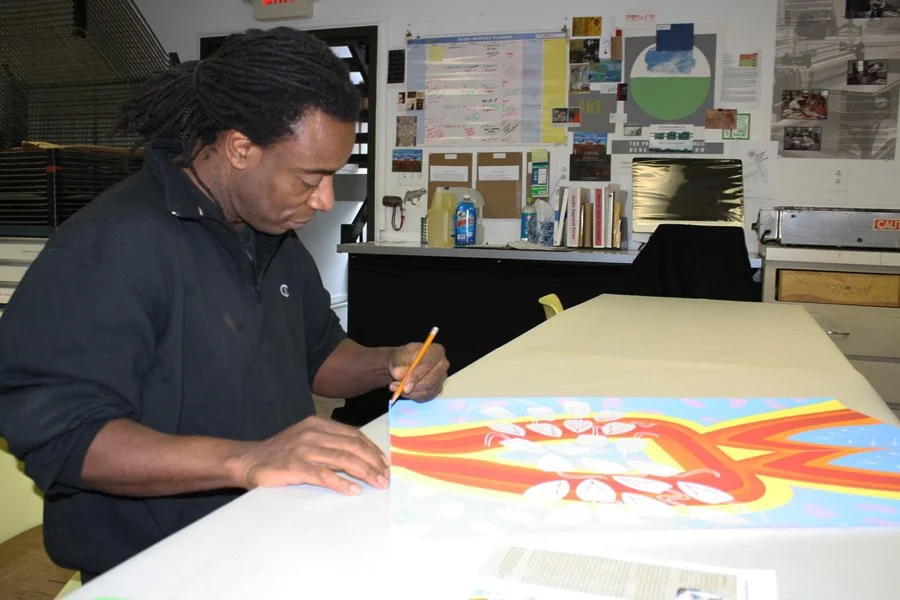
Willie Cole signing Home and Hearth, 2012 © Raven Editions, 2026
Cole gained a Bachelor of Fine Arts degree from The School of Visual Arts, New York in 1976. Cole’s work has been selected to be part of the public collections of the High Museum of Art, Atlanta, GA, the Birmingham Museum of Art, AL, The Bronx Museum of the Arts, New York, the Museum of Contemporary Art, Chicago, IL, the Cleveland Museum of Art, OH, the Dallas Museum of Art, TX, the Detroit Institute of Arts, MI, The British Museum, London and the Yale University Art Gallery, New Haven.
Cole’s work is represented by Alexander and Bonin Gallery (NYC), Maus Contemporary Gallery (Alabama), Gavlak Gallery (Los Angeles/Florida), and Kavi Gupta Gallery (Chicago).
Prints by Willie Cole
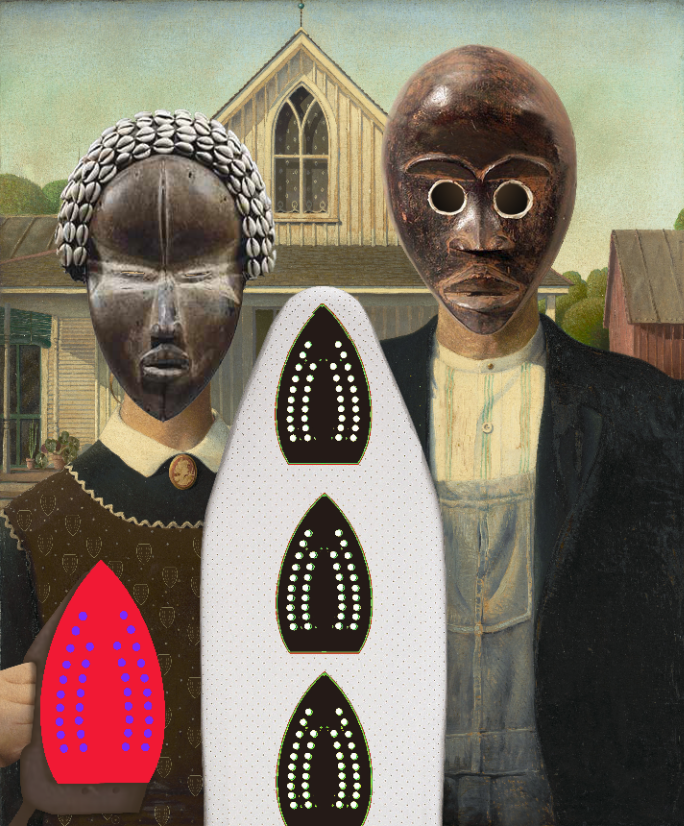
American Domestic
2016, Digital serigraph, 34 x 28 in
This print reinterprets Grant Wood’s iconic painting American Gothic by depicting two figures wearing Nigerian masks while holding an iron and ironing board—a symbolic nod to both domestic labor and Ogun. By juxtaposing these different art forms, Cole demonstrates the unique culture created by African Americans and emphasizes their role in the development of the American economy and culture.
The Ogun Sisters
2012, Serigraph/Relief, 33 x 22 in
The use of steam irons in Cole’s work represents the domestic roles of women of color as well as Ogun, the Yoruba god of iron and war. In this print, you can even find the atomic number for iron as a numerical and symbolic reference to this history. The two women in this image are from The Bordentown School (also known as Tuskegee of the North). It was a residential high school for African American students, located in New Jersey, that taught domestic skills, a.k.a., how to be a maid.

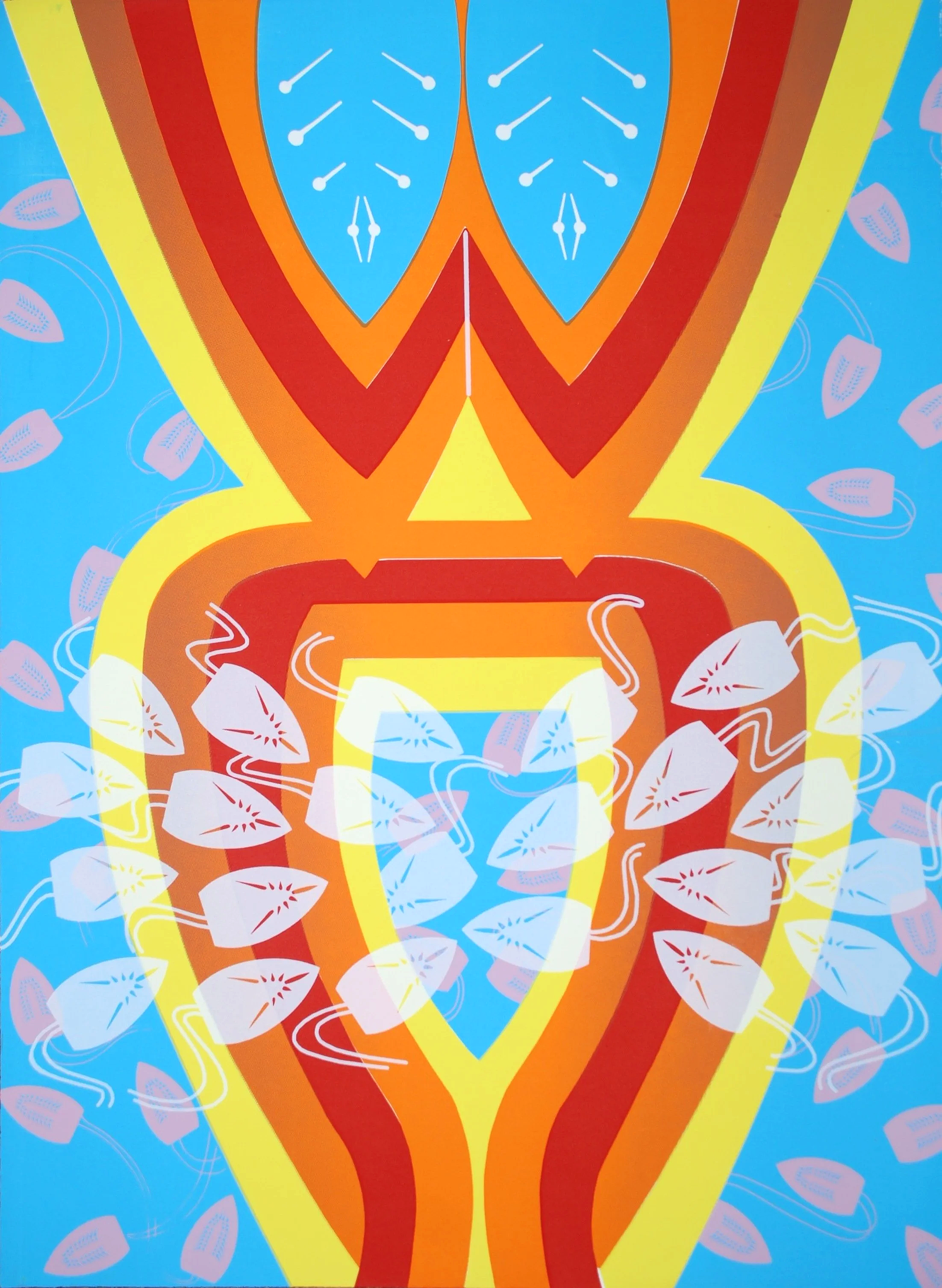
Home and Hearth
2012, Serigraph, 30 x 22 in
In this print, Cole’s composition was developed through experimenting with cut-out forms such as the inner thigh of a woman, a pendulous abstracted breast, and the sinuous lines of fluids. The emblematic flat iron icon represents the fecundity of womanhood and the motile energy of the male. Together, they represent the idea of heated origin, or conception. The various blues symbolize the goddess Yemaya, whose element is water. The male spirit is represented by the yellow-orange and by the translucent sperm shapes swimming around and through the female form.